As of 2018, while 44 states required arts education, only 20 made it count for graduation. This shows the impact of art education policies on creating equal opportunities for all students.
Arts education policies can lead to big changes across all education levels. They ensure arts are a core part of learning, support research, and provide fair funding. By restoring funding from institutions like the National Endowment for the Arts (NEA), we take an important step forward.
In New York City, funds for art supplies dropped significantly between 2006 to 2013. This underscores the need for policies that back art teachers and foster collaboration. It’s crucial to bring back strong federal leadership in art education.
Art education shapes creative minds, builds emotional intelligence, and encourages new thinking. That’s why pushing for strong art education policies matters for everyone, not just students.
Key Takeaways
- As of 2018, 44 states required districts to offer arts education.
- Only 20 states included arts courses to fulfill graduation requirements in 2018.
- In New York City, spending on arts supplies dropped by 84% from 2006 to 2013.
- The NEA’s annual funding was $167.5 million in 2021.
- Sound arts education policies can drive educational system change and ensure equitable access to arts for all students.
Importance of Including Arts Education in Every Child’s Curriculum
Adding arts education to all curriculums can greatly help a child’s growth. It lets them explore diverse art forms like music, theater, and paintings. This encourages creativity, improves how they think, and helps them understand their feelings better. Sadly, many schools still focus on old European arts, missing out on arts from different cultures.
Research supports the need for arts in schools. Yet, in New York City, only 45% of elementary and 33% of middle schools had a good art program in 2007-08. California saw even lower numbers, with 89% of K-12 schools not meeting art education standards. Most of these schools didn’t even have an art teacher. This shows that art education isn’t available equally for everyone.
Benefits to Cognitive and Emotional Development
Art helps kids in many ways. It can make their motor skills and coordination better by up to 57%. Schools with strong art programs see a 30% rise in students’ problem-solving skills and brain development. Art also makes them feel better about themselves. It lets them show their feelings and be more creative, boosting their confidence. Research found that 85% of students felt more confident after doing art.
Broadening Educational Perspectives
Arts in education make students think in new ways. By learning about diverse art forms, they start to appreciate different cultures and creativity. Moving past the usual European art to include global arts enriches learning. It makes the classroom more welcoming for everyone. Studies show adding arts can increase how well students finish projects by 80%. It also helps them do better in other subjects by improving their problem-solving abilities.
Funding and Resources: Ensuring Equitable Access to Arts Education
Equal access to arts education needs enough money and resources. This is especially important in Title I schools, which often lack funds. When President Obama reauthorized the Elementary and Secondary Education Act (ESEA) on December 10, 2015, it was a big step. It meant less federal control and more state freedom in using funds, helping start specific programs.
Title I funds are crucial for keeping arts education fair. The renewal of these funds kept the Assistance for Arts Education fund alive. It shows the importance of arts and music in education. Now, arts and music can get money from new grants managed by states. This helps ensure enough funds for arts materials and teaching various artistic skills.
The American Rescue Plan Act of 2021 set aside over $122 billion for schools from kindergarten to 12th grade. They said 90% of this should go to state and local education agencies. A big part of this money should support proven interventions, like after-school programs that include the arts. Plus, $81 billion of ESSER funds has been sent to states. The rest, $41 billion, waits for approval based on plans for safely reopening schools and maintaining operations.
In Title I schools, there’s often not enough money for art supplies, making it hard for teachers. Sometimes, teachers even spend their own money. So, it’s crucial to have strong funding and resources for a broad and reachable arts program. With enough money for supplies and a focus on fairness, communities can enrich their culture and boost various artistic skills.
The Every Student Succeeds Act (ESSA) and advocacy by Americans for the Arts push for more funds. Under ESSA, the Assistance for Arts Education program got an extra $500,000 in 2021, reaching $31 million. Yet, Americans for the Arts has asked Congress for more, $40 million in 2022, and full funding of $1.6 billion for certain grants. Advocacy is key to grow and keep arts programs throughout America.
To really ensure fair arts education, we need both money and supportive policies. It’s about valuing the arts as a core part of schooling. Continuing this fight gives every student, no matter their background, a chance to discover and grow their artistic talents.
Arts Education
The importance of arts education is huge for creating well-rounded, successful students. It greatly improves academic success, motivation, and attendance.
Understanding the Current State of Arts Education
Arts education in the U.S. shows big differences from one area to another. Although 44 states require arts education, only some make it a must for graduation. This shows we need clear rules to make sure every student gets to study arts, no matter where they are.
Not all students get the same chance to learn about the arts. Those from less served areas often miss out. This issue points to a real need for changes in policies and more support to make arts education fair for everyone.
Core Academic Subject and Course Requirements
Arts need to be a main subject with specific course needs for graduation. This change would mean students must study arts for two years in high school. It improves grades and teaches important skills like creativity and problem-solving.
Thanks to funding and programs from places like the Arts Education Partnership, support for arts education grows. They help teachers and artists give students a better learning experience. This celebrates and helps arts education thrive.
Collaboration and Partnerships in Artsscheme in Arts Education Education
Working together in arts education is key to making arts programs better. When schools and community artists join forces with policy makers and cultural institutions, art becomes a bigger part of learning.
Cross-sector partnerships are huge in spreading arts education. The Arts Council gives up to €40,000 for their Early Learning and Childcare Scheme 2024. This plan includes Early Learning, Childcare, International Protection, and Combined Contexts, making art accessible to all.
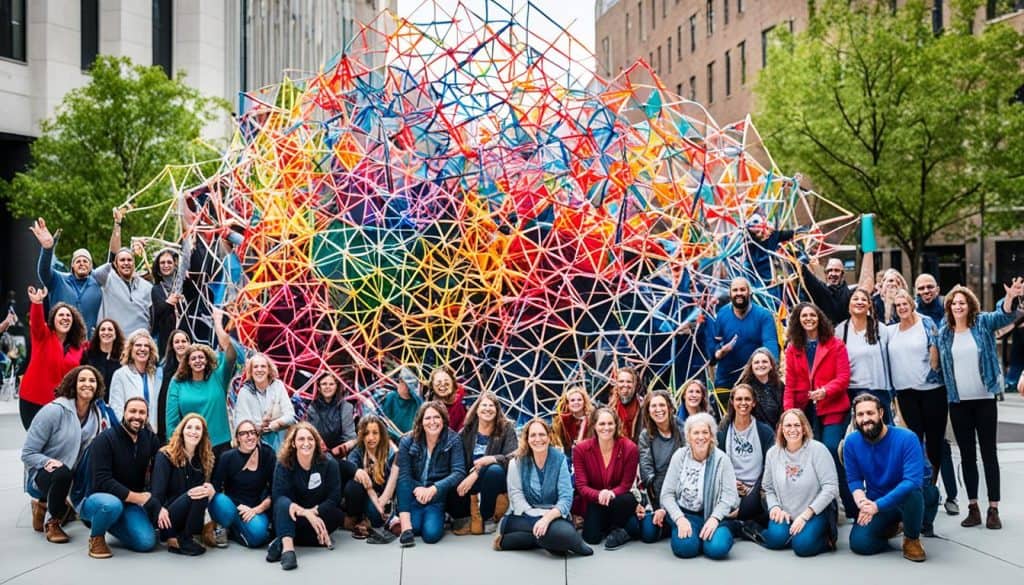
Community involvement is crucial for the Arts in Early Learning and Childcare Scheme. It connects young children with professional artists and arts organizations. This happens in various places across Ireland, encouraging kids to start enjoying art early on.
The Visual Arts Partnership lets local art groups host exhibitions, creating a lively art scene. The Arts Housing Scheme also offers spaces for art groups within the SCCC. This is home to groups like Drum Feng and Jazz Association (Singapore), showing the power of cultural diversity.
Artspace@SCCC is a place for artists to display their work. It strengthens community arts by letting local artists create together. Projects like RE•MIX 2K22 and #SINGAPO人 show the Centre’s role in arts education and community projects.
To wrap up, joining hands in arts education and partnerships pushes art learning forward. It brings together communities, support from institutions, and active collaborations. This mix helps make art education strong and impactful for everyone.
Advocacy and Policy Recommendations for Enhancing Arts Education
Advocating for arts education is key to changing policies and getting full support for creative subjects in schools. We need to update arts education laws and policies to meet today’s educational needs. Right now, only 57% of eighth-graders get regular music classes and just 47% have visual arts classes several times a week. It’s clear we need to try harder to support arts education.
The National Task Force on the Arts in Education (NTFAE) report highlights the need for working together with educational and arts groups. This report, which took almost two years to make, asks for more money for groups like the National Endowment for the Arts (NEA). It also wants more chances for teachers to learn and grow. These steps would make arts education better and help students get a rich, wide-ranging education.
We need to make the government focus more on arts in education again. Making policies stronger at the state and district levels will help all students. Groups like the National Art Education Association (NAEA), with over 54,000 student members, and the National Association for Music Education (NAfME), with more than 57,000 members, show how important this support is. Their work proves that good advocacy can really improve education for the future.